Plaster or Cement Goose and Baby Lawn Ornaments
Nothing Says Midwest Like a Well-Dressed Porch Goose
Bringing people together since the 1980s
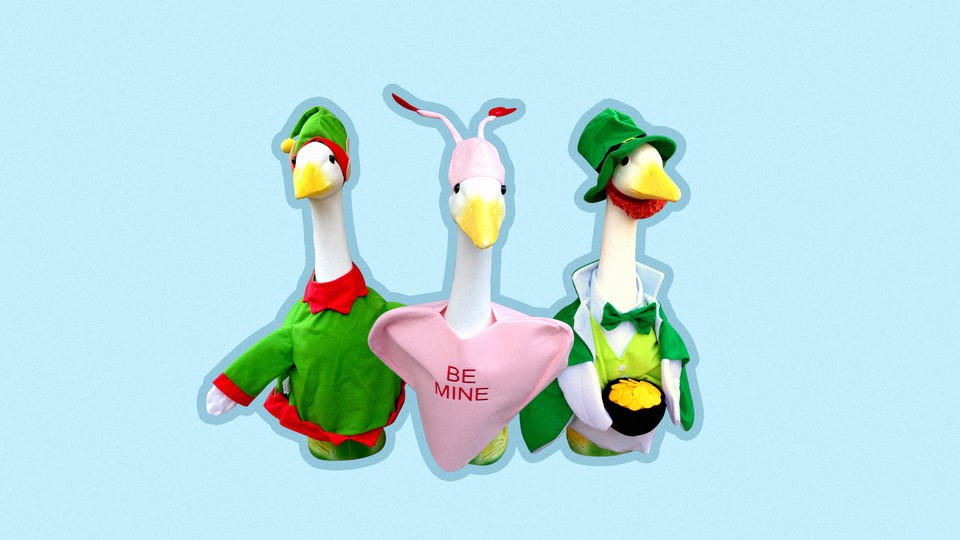
When the creators of the long-running ABC sitcom The Heart, about a middle-grade family living in Indiana, were coming up with the bear witness's aesthetic, there was ane prop they knew they had to have, to give the Hecks' family habitation 18-carat Midwestern flavor: a statue of a concrete goose to keep on their porch. And outfits to dress information technology up in.
"Our showrunners are natives of Indiana, and they gave me guidance on the region's unique grapheme," says Julie Fanton, 60, who served as The Heart's set decorator for the prove's unabridged run, from 2009 to 2018. "They told me about that, and I said, 'They practise what? They dress upward their lawn ornaments?'"
They do. In suburban and rural towns across America, but mostly in the Midwest, a minor but persistent subset of porches play host to these geese, whose outfits go changed seasonally, and sometimes according to the weather. Y'all might encounter a goose statue dressed every bit a pumpkin effectually Halloween, or equally Uncle Sam for the Fourth of July. I reported most of this story the calendar week of Thanksgiving, and several goose owners I spoke with had dressed their geese as pilgrims for the holiday.
Growing up in Michigan, I would regularly stop past my neighbour Shirley'due south house, three doors downward from my parents', to check out her goose's various costume changes. A few other homes in the neighborhood had geese as well, merely I thought nothing of it until I moved to the E Coast every bit an adult and realized i mean solar day that I hadn't seen a goose statue in years. Little regional quirks such as lawn geese are similar the scent of home—you accept to go out and come back to notice them.
That'southward how a contempo homecoming went for Patricia Lockwood, a 36-year-one-time poet and popular Twitter humorist. She returned to Cincinnati, Ohio, where she grew up, to help her sister after a medical emergency. (She now lives in Savannah, Georgia, she told me.) She noticed the geese anew while driving around town, which prompted her to tweet, "Is it ... normal ... in other places that people have a concrete goose in their front yard that they dress up according to whether it's raining or not." (The most popular goose outfit, said one retailer I spoke with, is a rain slicker, and some people actually do put the coat on and take it off equally the rain starts and stops. "They're super on the ball," Lockwood says.)
The origins of this practice are murky, just a search of local-paper archives and discussions with the couple lawn-ornament scholars I was able to notice by and large suggested that dressed-up lawn geese beginning caught on in the 1980s and gained popularity through the '90s. A brief commodity on lawn ornaments by the American-studies scholar Fred Due east. H. Schroeder in The Guide to United states Popular Civilization states, "Concrete geese, elaborately dressed in a multifariousness of costumes, became a popular regional type in the 1980s along the upper Ohio River." Slightly complicating matters, a 1998 article in the Chicago Tribune (titled "Fashionable Lawn Geese Get Down Big Fourth dimension") claims an earlier debut: "Lawn geese outset began popping up in American suburban front yards in the 1950s." The trend of dressing them may be what took off in the late 20th century. "Lawn geese clothing appears to be an hole-and-corner fashion rage in the 1990s," the Tribune article continues.
At any rate, the Ohio-based retailer Goose Dress Galore definitely got its first in 1981, subsequently Marijane Cole, a folk artist, started getting requests from a garden middle to make clothes for concrete geese. They sold well enough that she founded Goose Dress Galore. Later she broke a hip around 2000, her son James, at present 61, took over the company, which he refers to as a "giggle business organization," more than an established philosophy than an off-the-cuff remark. "It's about making people smile," he says. He has been using the phrase since at least 2006.
Why geese, specifically, caught on in this way is anybody's guess. The bird just seems to be embedded in the midwestern subconscious for some reason—possibly because geese fly over the region on their way north to Canada in the summer? James Cole suggests that it'south because early on European settlers brought geese with them to Ohio. The Ohio History Connection, the land'south historical guild, was unable to verify this theory—though to their credit, they took my ridiculous research very seriously.
The strongest theory comes from Colleen Sheehy, the president of Public Art Saint Paul in Minnesota, and the author of The Flamingo in the Garden: American Yard Art and the Colloquial Landscape. "The American yard with its emphasis on the green infinite of the lawn references the idealized American landscape of the subcontract," she told me in an email. "And then geese are part of a whole menagerie of subcontract beast imagery that appear in American yard art—along with miniature farm windmills, old subcontract equipment fabricated into sculptures, old-fashioned water pumps, milk cans, and the like ... Places where people who grew up on farms accept moved into suburbs or cities are places where farm imagery is used to communicate their continued honey for and affinity with rural landscapes."
I defenseless Cole during what is apparently the busy flavour for goose-clothing sales: the lead-up to the winter holidays. "Any major vacation where people would decorate their house or put something in their yard" prompts a spike in orders, he says.
The internet fabricated finding goose outfits much easier for those interested. It's where Fanton turned when tasked with dressing lawn geese for the prepare of The Center. "I just went online and lo and behold, information technology's a thriving industry," she says.
Goose Apparel Galore (from which Fanton purchased some outfits) is one of several online retailers dedicated to goose vesture; their websites all accept, perhaps fittingly, a ... homemade feel. They have a niche customer base, but a seemingly dedicated one. The fun of owning a goose is in regular outfit changes, later on all. Multiple sources I spoke with referred to lawn geese every bit "Barbies for adults."
"I like my goose to be well dressed, and I like to alter her outfits frequently," says Callie Appelstein, a 44-twelvemonth-old mother of two who lives in Kirkwood, Missouri. "At least monthly, but it depends on when inspiration strikes." Her goose, Goosey, has outfits for most major American holidays, as well as a "'50s sock-hop outfit with a poodle skirt, and a sunflower outfit for springtime."
Amanda Weber, a 47-yr-former proofreader in Durham, Due north Carolina, has "at to the lowest degree 80" outfits for her goose, Goosie (spelled with an I-E as opposed to Appelstein's E-Y. I checked.). Some of them she bought online, and some she made herself. Her favorite is a Prince costume. She got her goose as a wedding gift from her female parent, who had 1 when Weber was young.
It'due south more challenging to observe the geese themselves for sale online than it is to notice their outfits. And for good reason—the concrete ones can weigh effectually 65 pounds. Plastic ones are easier to come by, but they take their own disadvantages. Appelstein's is plastic, and "we had to weigh her downward with some gravel because she blew over all the time."
Nancy Gardner, who started her company, Lawn Goose Designs, out of her habitation in 1994, used to sell the concrete geese online, but she had to work with a aircraft company to get a custom-made box for the heavy statues. "They dropped the thing off buildings [to test it]; it was a big deal," she says. But notwithstanding, the geese are so expensive to ship that she says she probably won't do it ever once again.
Gardner likely won't have to make that determination anyhow, considering Lawn Goose Designs is shutting down. One of her designers recently quit—she was getting older and having health problems. "When I lost her, there was merely no way to continue everything going," Gardner says. If she finds another seamstress to step in, maybe she'll reopen, but she says she'southward thinking of starting a nutrition business organization instead. Gardner, 68, has lived a life total of career shifts already; she started out as a Playboy Bunny, then worked in corporate administration, and then ran a brick-and-mortar goose-clothing store earlier taking the concern fully online. Backyard Goose Designs was a side concern until she was laid off from her corporate chore during the Great Recession, later which she says "this footling bit of income [from Backyard Goose Designs] actually saved my life."
The recession hit the goose-apparel manufacture pretty hard, Cole says: "They're not going to buy goose apparel if they can't feed themselves." Only Gardner says her business organisation survived in spite of that downturn "because it'due south a unproblematic pleasure."
Cole's business concern has recovered since then, and he now has customers across the United States, not just in the Midwest. The main people who buy goose clothes, he says, take ever been suburban and rural homeowners, typically middle-aged or elderly women. Merely Cole, Gardner, and others said they're seeing a new, younger wave of goose dresser-uppers. (Lockwood chosen it a "hipster resurgence.")
"Young people have inherited their goose, in many cases, from their grandmas," Gardner says.
Stacey Kingdom of the netherlands, a 32-year-sometime office manager in Rogers, Kentucky, got her goose from her great-grandmother. "When she passed away in '98, my mom got it, and in 2010 she casually mentioned to me she was going to get rid of it at an art auction, and I said, 'No way.' It reminds me too much of Grammy." Her family displayed the goose on their back patio, up until i fateful day when Holland was bankroll her truck close to the house to offload some piece of furniture and accidentally hit the goose, decapitating it with her fender. She plans to fix the statue and become it repainted then her 3-twelvemonth-old daughter can savour it the fashion she did when she was young.
This intergenerational passing of lawn geese may have contributed to the exercise'south spread beyond the Midwest to other regions of the state, though information technology however seems uncommon in many places. Only the internet likely helped, besides. When Erika Cohen, 95, moved into an assisted living home in Jonesboro, Arkansas, she remembered a dressed-upwards backyard goose she used to run across in town and wanted to get one for her new dwelling. "They must take gotten their clothes somewhere, so I just put on the computer, Where do you lot buy apparel for geese? And I found out, didn't I?" she says.
A brightly dressed goose on a porch may brand for a charming neighborhood ambassador, but it is also exposed, and vulnerable to shenanigans.
In their heyday in the 1990s, the high visibility of neighborhood lawn geese made them a regular target for pranks, both good and ill-natured. Co-ordinate to a front-page story in the Fremont, Ohio, News-Messenger, titled "It'due south Lawn Goose Season Again," at that place was a "rash of anti-goose criminal offense that plagued the county from summertime 1991 all the mode through January [1992]." A reader wrote to the paper suggesting that vandals who damaged or stole the geese were starting "a long overdue motion to rid our neighborhoods of tackiness," while a local psychologist expressed concern that the goose-nappers were "making an anti-social statement."
Lockwood has another theory. She says that in her town growing up, "it was a rite of passage for loftier-schoolhouse boys to steal [the geese] around graduation time." Her male parent was a teacher at the loftier school, and one twelvemonth, she says, a bunch of his male students stole some goose statues and surrounded his automobile with them. She hypothesizes that the older women who ain the geese "know maybe that the boys are going to steal them at some indicate? It's like a puberty ritual; they're putting the goose forward to allow the boys to steal information technology so that they can become men."
In July 1994, a goose-napping made the front folio of the Akron Buoy-Journal. The concrete goose had gone missing from Frances Walters's yard 11 days before, but this time there was a twist. The kidnappers sent Walters a postcard from the goose, which they named Beak, featuring a picture of Bill in forepart of Mount Rushmore, wearing the bikini and sunglasses information technology had been wearing the night it was stolen. "Still having a great time! Encounter you before long. All my love, Neb," the postcard read in part. The Beacon-Journal covered Bill's journey the residual of the summer, and the editor in chief even wrote a column begging him to come home. Virtually three months afterward he was stolen, he was returned, and "Mrs. Walters laughed through the reunion," according to an obituary for Walters the paper ran after her death in 2000. Whatever that psychologist's concerns, this seems like a pro-social goose-napping if ever I heard one.
However exactly this tradition came to be, the lawn goose abides, because it is a nexus of connection. Wheresoever a goose statue is dressed in a silly outfit, there, also, will be non only pranksters, but children laughing and neighbors striking up conversations over it.
"People in the neighborhood started telling me how much they enjoyed seeing his costumes," Weber says of her goose, so she made a Facebook folio for Goosie, which now has a small but very engaged following.
This may be why the backyard goose is popular amidst "elderly women who live solitary and really don't have anybody to talk to," according to Cole. "Some of them are a little alone." He says he knows a few of his customers pretty well, because they'll call him to make an society, but they really just want to talk. "We talk about everything," he says. "The weather, our health bug, anything else. Equally much time as they wanna talk, I let them talk."
"Even though information technology seems frivolous, anything that can make somebody smile for a moment is a contribution to society," Cole says. He calls backyard-geese enthusiasts "an hole-and-corner society," though it'south not a very secretive one. But perchance, just every bit homeless wanderers once marked homes they passed through with symbols to indicate the nature of those who lived there—kind or dangerous—a goose on a front end porch dressed in its vacation all-time is a symbol that whoever lives inside is seeking connection and community.
Source: https://www.theatlantic.com/family/archive/2018/12/where-people-dress-porch-geese-seasonal-outfits/577153/
0 Response to "Plaster or Cement Goose and Baby Lawn Ornaments"
Post a Comment